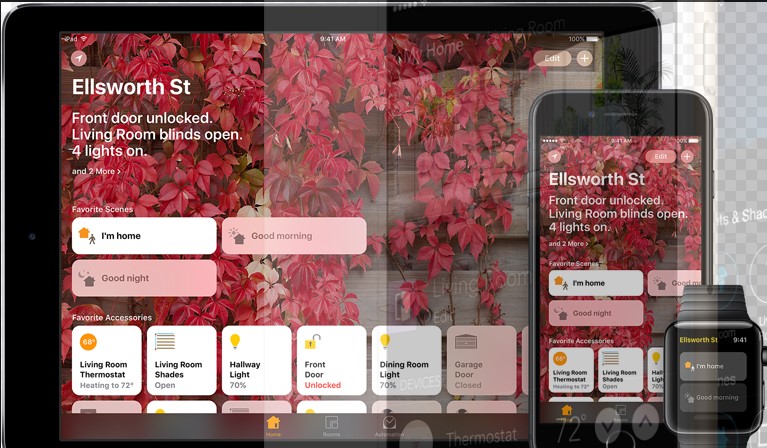
While most home automations are extremely competent while operating ‘Real Hardware Homeware’ from inside of the home, the real capability is how well they fare when being out of home.
By Real Hardware, I mean stuff like Digital Locks, or connected lighting, thermostats, or air conditioners and not services like booking an Uber or ordering a pizza etc.
Out of home operation for hardware is extremely important as one would always imagine, there are very valid use cases around it.
Some most common examples being:
‘I want to let my friend inside my home on a Friday evening, I will get a little late hence need to unlock my connected lock’
‘I want to Turn selected lights in my House ON as it’s already dark and my pet is in all alone’
‘I want to switch on the AC now, I will reach home in 10 mins but that time the place will be comfortably cool’
The 3 leading smart home systems have varied levels of capability in terms of ‘Out of home capability’. The 3 systems being Apple Homekit, Google Home, and Amazon Echo.
Before we get into capability comparison, let us just run through the basic architecture of Smart Home systems. With this we will appreciate the capabilities much better.
Below I present the architecture in most generic fashion and then we will go through various connectivity scenarios:

Scenario 1

Smart Device issues command to Cloud, Cloud issues commands to Hub through the router, Hubs get the commands executed by the Smart Objects.
All the functionalities work in this condition – one can use touch on the smart device’s apps, voice commands on Apple Siri, Google Home etc.
Scenario 2

Smart Device issues command to the router directly.
If the command is through touch on the app then the router passes the command to the hub and gets it executed by objects
If the command is through voice then the router passes the command to the cloud to get response to what that voice command means, once the router receives the manifestation of the command from cloud, it passes the command to hub and gets it executed by objects.
Scenario 3

The Smart device issues the command to the cloud but there is no connectivity from the cloud to the router. Hence Out of Home functionalities will not work – neither from touch App nor from Voice Assistant on the device.
Scenario 4

Smart Device passes the command to the router directly.
If the command is through touch on the app then the router passes the command to the hub and gets it executed by objects
If the command is through voice then the router has to pass the command to the cloud to get response to what that voice command means, but since the router is off internet it cannot communicate with the cloud hence voice based command will not get executed.
Having seen this basic architecture, let us now see what do the Smart Home have to offer us in terms of Voice as well as Out of Home capabilities.

So quite clearly, Amazon has some catching up to do, but then who wins the race out of Apple and Google!
Apple always had great Out of Home control because of the solid architecture as the above table explains.
Cost to setup and get going!
Google has now come of age with assistant being rolled out to other Smart devices. The Google legion is spreading fast. It’s effective, fast, easy to setup, and far more economic when compared to Apple. The static Google Home Hub is roughly 8,000 INR (100 – 130 USD) versus a static Hub from Apple (Apple TV 14,000 INR, iPad> 20,000, iPhone> 25,000).
Out of home capabilities – the final word
Amazon has a lot of catching up to do in terms of Out of Home capability. Widespread roll out of Alexa app will help but sheer number of Android users will definitely be a mammoth task to convert from naturally inclined Android based systems to Alexa. On the other hand, iOS users have always been die hard fans – next to impossible to convert.
So Google has played an equalizer to Apple, Right?
Hmmm.. Not yet. Apple still is a step ahead. In scenario 4 (As explained in the table earlier) Apple Homekit will work but not Google Home. The reason is straight forward – Apple Home has a well-defined UI so when Siri based voice command doesn’t work on can always fall back to touch option something that Google Home is still to create. Google Home is plain voice based.
Having made this comparison but still reiterating, Google Home is far easier and economic to setup!
So who really wins the Out of Home Race?
If I was to opine, Apple Home is marginally ahead of Google Home just for the UI. Amazon still has a lot of work to do in terms of hardware integrations and out of home assistant.
I personally prefer Google Home and Google Assistant works like magic on my Smart Phone both Out of Home as well as inside it. Have a look!
Leave a Reply